
25 Years Later, Nepal Gets a New Transport Policy: EVs, Road Safety and Smart Mobility Take Centre Stage





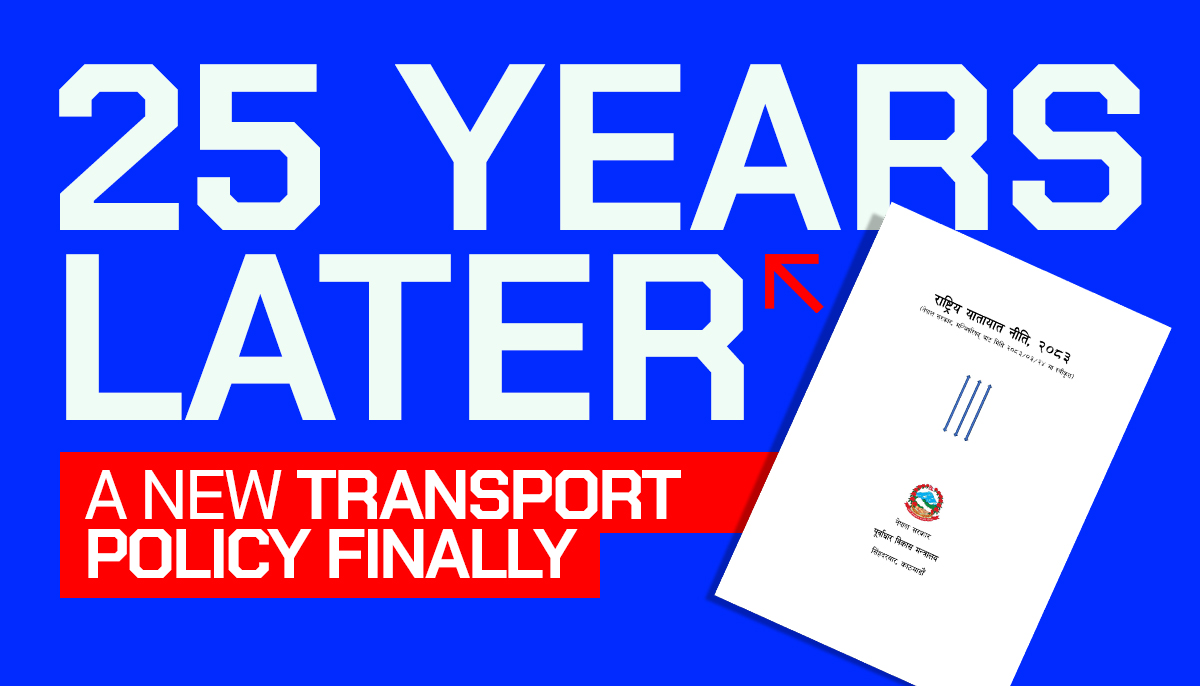
Nepal’s transport sector is set for its biggest policy shift in decades.
The Council of Ministers has approved the National Transport Policy 2083, replacing the transport framework introduced 25 years ago in 2058 BS.

The new policy arrives at a crucial time for Nepal’s mobility landscape. Electric vehicles are rapidly changing the automotive market, cities are facing increasing congestion, and road safety remains one of the country’s biggest transport challenges.

Formulated by the Ministry of Infrastructure Development, the policy aims to create a more modern, safer and sustainable transportation ecosystem.
From expanding electric mobility and upgrading public transport to improving emergency response, introducing digital systems and connecting different modes of transportation, the framework attempts to redefine how Nepal moves in the coming years.

Main Highlights of National Transport Policy 2083
1. Accelerating EV Adoption and Green Mobility Transition
Electric mobility has been placed at the centre of Nepal’s future transport strategy.
Electric Public Transport Priority: Electric buses, taxis and microbuses will receive priority in urban transportation systems. Federal, provincial and local governments will also be encouraged to expand the use of electric vehicles in their own fleets.
Charging Infrastructure Expansion: The policy focuses on developing a nationwide EV support ecosystem through charging hubs, battery-swapping stations and dedicated “Green Corridors” to improve charging accessibility.
Vehicle Scrappage and Fleet Renewal: A National Vehicle Scrappage and Fleet Renewal System will be introduced to gradually remove old, highly polluting and unsafe vehicles based on age, emission levels and safety standards.
Support for Electric Mass Transit: The government plans to introduce financial mechanisms, including Viability Gap Funding (VGF), to attract private investment into large-scale electric public transportation projects.
2. Major Shift in Road Safety and Emergency Response
Road safety receives significant attention under the new policy, with the government adopting the internationally recognised Safe System Approach.
Reducing Road Fatalities: The policy aims to reduce deaths and serious injuries by improving road design, enforcement, vehicle standards and emergency response systems.
Mandatory Safety Audits: Road Safety Audits (RSA) and crash investigations will become mandatory for major infrastructure projects. High-risk locations or “black spots” will be identified and upgraded with corrective measures.
Faster Emergency Response: Specialised Trauma Care Units will be established along strategic highway corridors to improve post-crash treatment during the critical “golden hour”.
Support for Accident Responders: The policy proposes legal protection and incentives for Good Samaritans who help accident victims at crash sites.
3. Rethinking Urban Mobility and Traffic Management
With growing cities and increasing vehicle numbers, the policy aims to shift Nepal towards more organised urban transportation.
Mass Transit Focus: Urban mobility will gradually move towards solutions such as Mass Rapid Transit (MRT), Bus Rapid Transit (BRT), electric buses and tram systems along high-density routes.
People-Centric Roads: Cities will adopt Complete Street concepts, ensuring roads are designed not only for vehicles but also for pedestrians, cyclists, elderly citizens and people with disabilities.
Congestion Management: Cities may introduce measures such as staggered office hours and peak/off-peak fare systems to better manage traffic demand.
Parking and Heritage Zones: Proof of off-street parking could become compulsory for certain vehicle registrations, renewals or ownership transfers. Historic and tourism areas may also be converted into pedestrian-only or low-emission zones.
4. Integrated Transport Network and Regional Connectivity
The new policy aims to move Nepal away from isolated transport planning by connecting different modes into one integrated system.
National Multimodal Transport Masterplan: Highways, railways, airports, inland waterways, ropeways and cable cars will be planned under a single integrated network.
Improved Trade Connectivity: Integrated Check Posts (ICPs), dry ports and border infrastructure will be upgraded under regional connectivity frameworks such as BBIN, BIMSTEC and SASEC.
Digital Axle Load Monitoring: Automated weigh-in-motion systems will be introduced on major trade routes to control overloading and protect road infrastructure.
5. Digital Transport Governance and New Financing Models
The policy also brings major changes to how Nepal manages transportation.
Digital Transport Platform: Paper-based transport systems will gradually be replaced by a Digital Transport Data Platform for real-time monitoring of vehicle registrations, driving licences and enforcement.
Smart Traffic Enforcement: Automated speed cameras, Intelligent Transport Systems (ITS) and digital demerit tracking through Smart Driving Licences will replace traditional manual monitoring methods.
Alternative Transport Financing: As EV adoption reduces dependence on fossil fuel-based revenue, the government plans to explore options such as green bonds, carbon credit systems, congestion charges and road pricing.
Kathmandu Valley Transport Authority: Public transportation in the Kathmandu Valley will be managed through the proposed Federal Capital City Public Transport Authority (FCCPTA).
Division of Transport Responsibilities Under Federal Structure
The policy also establishes clearer responsibilities among the three levels of government.
Federal Government: Responsible for national transport policiy, overall standards, cross-border connectivity, national highways, railways and monitoring.
Provincial Governments: Oversees provincial highways, vehicle registrations, driver licensing, and regional public transport regulations.
Local Governments: Manages municipal roads, parking management, urban traffic management, and last-mile connectivity.
A New Chapter for Nepal’s Mobility Sector
The approval of National Transport Policy 2083 marks the first major update to Nepal’s transport vision in 25 years.
For the automotive sector, the policy could have far-reaching implications. The continued push towards electric mobility, improved infrastructure and smarter transport management could reshape how vehicles are bought, used and regulated in Nepal.
However, the real test begins with implementation. Building charging infrastructure, improving road safety, modernising public transport and ensuring coordination between different levels of government will determine whether this policy becomes a turning point for Nepal’s mobility future.








Royal Enfield Hunter 350 Gets New Variant and Colours in Nepal

GAC Motor Nepal Issues Statement on Aion Y Fire Incident in Bharatpur

Changan Nevo Q05 Launched in Chitwan